
2026

2026
A series of virtual conversations to analyze Venezuelan reality beyond the headlines.
Alianza Americas is organizing Venezuela: Elements for Understanding the Country, a series of four virtual conversations that offers a rigorous, contextualized, and balanced analysis of Venezuela's social, economic, and political transformations.
From the collapse of the oil-based democracy model to the consolidation of the Bolivarian project, and from the daily lives of families to the power structures that permeate the social fabric, this series seeks to answer a central question: How do the Venezuelan people live, work, and survive today?
Throughout four thematic sessions, experts will analyze:
The sessions will be held via Zoom, will last one hour, and will include simultaneous interpretation. Registered participants can submit their questions in advance.
Dates and Chapters
Register for the entire series: https://bit.ly/4aduN5J
You can watch the recording of the event here:
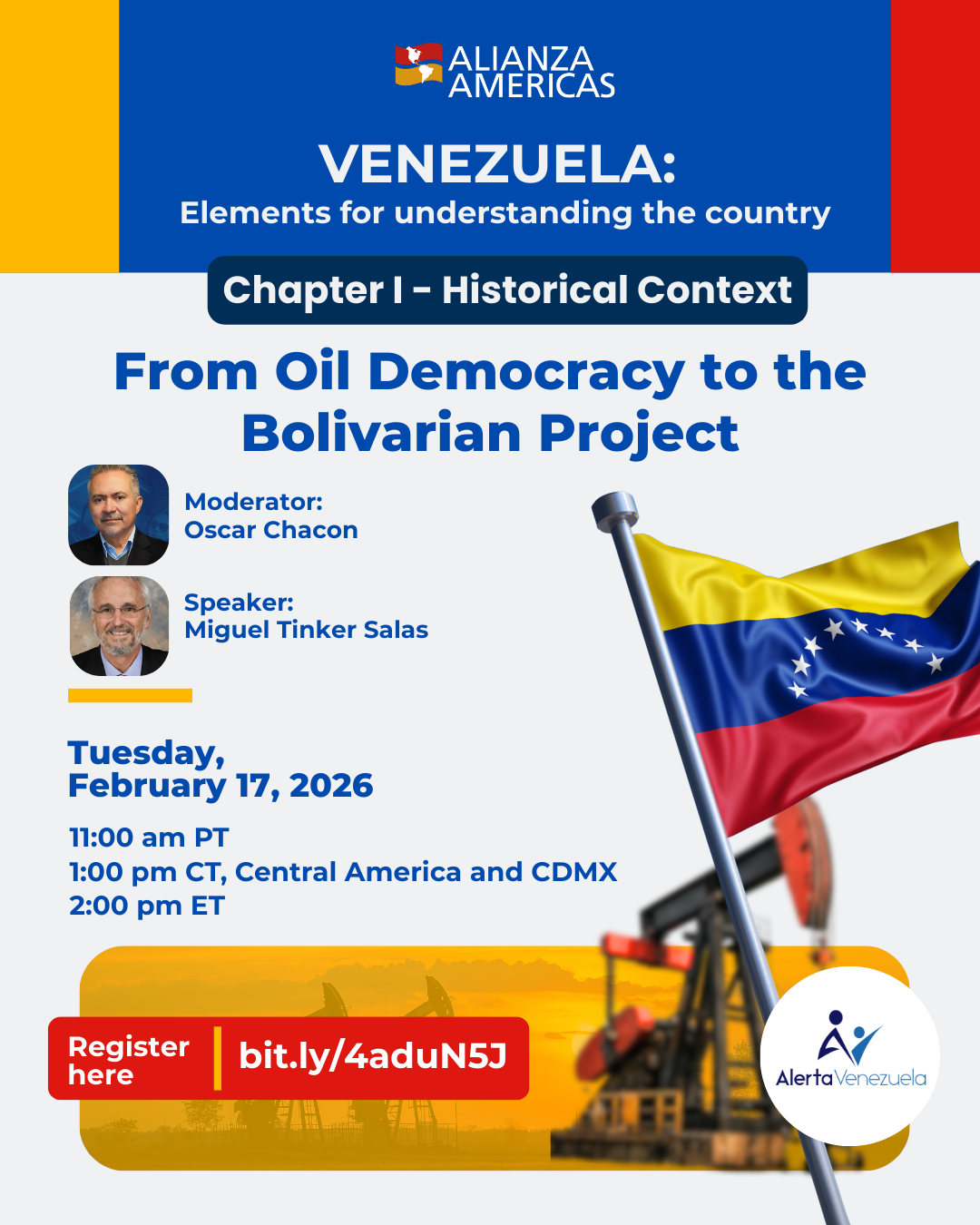
Chapter I: Historical Context: From Oil Democracy to the Bolivarian Project
In the first episode, we speak with historian Miguel Tinker Salas—a professor at Pomona College and author of The Enduring Legacy: Culture, Politics, and Society in Venezuela—about the historical roots of the Venezuelan crisis, tracing its trajectory from the emergence of the oil industry in the early 20th century to the present day.
The historian examines the historical roots of the Venezuelan crisis and how the discovery of oil in 1922 radically transformed the country. Venezuela shifted from being an exporter of cocoa and coffee to becoming—by 1928—the world's leading oil exporter; a pivot that turned its back on Latin America and reoriented the nation toward the United States and England.
Under the dictatorship of Gómez, the modern state took shape in parallel with the oil industry. Oil acquired a strategic military value that led the United States to regard Venezuela as a "cornerstone" of its reserves during World War II.
Tinker Salas deconstructs the narrative of Venezuela as an "exceptional democracy," explaining that this story was constructed both by U.S. interests—which, in the wake of the Cuban Revolution, promoted Venezuela as a regional showcase—and by national elites who conflated their own minority, middle-class experiences with the broader reality of the country. The Pact of Punto Fijo (1958), while resolving inter-party disputes, excluded the political Left and failed to address issues of poverty, inequality, or racism. Oil fields functioned as social laboratories that forged a middle-class identity aligned with the North American model. Oil wealth generated cycles of boom and bust; the "Saudi Venezuela" of the 1970s accumulated $30 billion in foreign debt in just three years, alongside a level of corruption that touched every president of that era.
This unsustainable model imploded with the *Caracazo* of 1989, which paved the way for the democratic election of Hugo Chávez in 1998 as the representative of a multi-class and multi-racial movement—one that the opposition narrative has sought to reduce to a mere aberration.
The conversation also addresses the nationalisation of the oil industry—fully compensated in 1976 and negotiated with U.S. assistance under the 1943 law—as well as Maduro's election as Chávez's successor within the context of Chavista "hyper-presidentialism." Furthermore, it examines the combined impact of plummeting oil prices, economic sanctions, and mismanagement, which triggered a GDP contraction exceeding 70% and the emigration of more than 7 million Venezuelans. Tinker Salas concludes by warning that Venezuela is currently undergoing a "tutored transition," in which decisions are made in Washington; he argues that any viable future requires reclaiming national sovereignty, reconciling the country's diverse perspectives, and addressing the structural tensions that have defined the nation since its inception.
Chapter II: Economy. Does Oil Truly Benefit Venezuelan Families?
In this chapter, economist Francisco Rodríguez—a Senior Research Fellow at the Center for Economic and Policy Research, a professor at the University of Denver, and the founder of Oil for Venezuela—analyzes the root causes of Venezuela’s economic collapse.
The conversation deconstructs simplistic explanations to examine how a country that once ranked among the 25 wealthiest in the world—boasting a per capita income comparable to that of the United Kingdom in the 1970s—suffered the largest economic contraction ever recorded outside of a wartime conflict, plummeting to income levels last seen in 1938.
Rodríguez explains the phenomenon of "Dutch Disease"—which, he argues, should more aptly be termed "Venezuelan Disease" and details why the national consensus to "sow the oil" never materialized. He states that the Venezuelan state—having never needed to legitimize itself by levying taxes on society—lacked both the autonomy and the technical capacity required to invest productively and diversify the economy.
Drawing on data and charts, Rodríguez demonstrates a strong correlation between oil revenues, GDP per capita, and poverty reduction—a finding that challenges the prevailing narrative that oil wealth has never benefited the general population. At the same time, he offers a nuanced analysis of the impact of U.S. sanctions: while the crisis began prior to 2017 with the collapse in oil prices, it was precisely as those prices began to recover that oil production itself plummeted. The monthly rate of decline accelerated from 1% to 3% following the financial sanctions of 2017, with further drops of 30% and 40% occurring in the wake of the oil-sector sanctions of 2019 and the secondary sanctions of 2020.
His conclusion, sanctions account for approximately half of the collapse in Venezuela’s GDP; consequently, the lifting of these sanctions is now fueling expectations of double-digit economic growth.
Looking toward the future, Rodríguez argues that economic recovery cannot be decoupled from politics. Venezuela needs foreign private investment to revitalize its oil sector; the state-owned company is bankrupt and unable to take on debt, yet political polarization deters investors—as illustrated by the warning from the CEO of ExxonMobil: "we have already been expropriated twice in that country" (in 1976 and 2007, under governments of opposing political stripes). The stability required for investment can only be achieved through broad political agreements that include all sectors, including the opposition.
Chapter III: Collectives and the Penetration of Chavismo into Society "Challenges and Fractures in the Social Fabric"
In conversation with sociologist Verónica Zubillaga, this chapter analyzes the origins and evolution of armed collectives in Venezuela.
The discussion traces their trajectory from neighborhood self-defense organizations in the 1980s—heirs to the leftist guerrilla tradition—to their emergence as central actors in territorial control and political repression. The 2002 coup d'état marked a turning point by establishing the doctrine of a "peaceful yet armed revolution," and the transition from Chávez to Maduro further entrenched these groups' role: lacking charisma, oil revenues, and unquestioned legitimacy, Maduro came to rely on them as key instruments of coercion.
Drawing on her ethnographic research, Zubillaga distinguishes between vastly different models of collectives: ranging from groups like La Piedrita (little rock)—which possess deep ideological roots and a genuine social orientation—to opportunistic groups such as Tres Raíces (three roots), which are dedicated to profiteering and the resale of food amidst a severe humanitarian emergency.
All of these groups operate within a "gray zone" situated between state formality and informality; their presence imposes, as the sociologist terms it, an "armed despotism" that permeates the daily lives of local communities. This dynamic fosters relationships that oscillate between clientelistic dependency and a profound fear. A fear that, particularly since 2024, has reached a point where residents are afraid to even speak to one another over the telephone.
Looking toward the future, the conversation warns against the risk of a "normalization" scenario—one that might combine economic liberalization with the continued entrenchment of the repressive apparatus. It underscores, instead, the urgent need for transitional justice processes—modeled after the Colombian experience—that address the actions of both the collectives and the security forces responsible for systematic killings.
Furthermore, the discussion highlights that the UN Independent International Fact-Finding Mission on Venezuela is currently preparing a specific report on collectives to serve as evidentiary material for the International Criminal Court; notably, prior field investigations had already anticipated the significant risk of armed conflict arising during any future political transition.
Understanding the complexity of Venezuela is a key step toward fostering fairer and more sustainable responses to its crisis.
At Alianza Americas, we remain committed to producing accessible information and rigorous analysis that strengthen the work of organizations, communities, and individuals interested in the region.
For more information about sponsorship opportunities, contact Dulce Dominguez at ddominguez@alianzaamericas.org
.png)


.png)


